
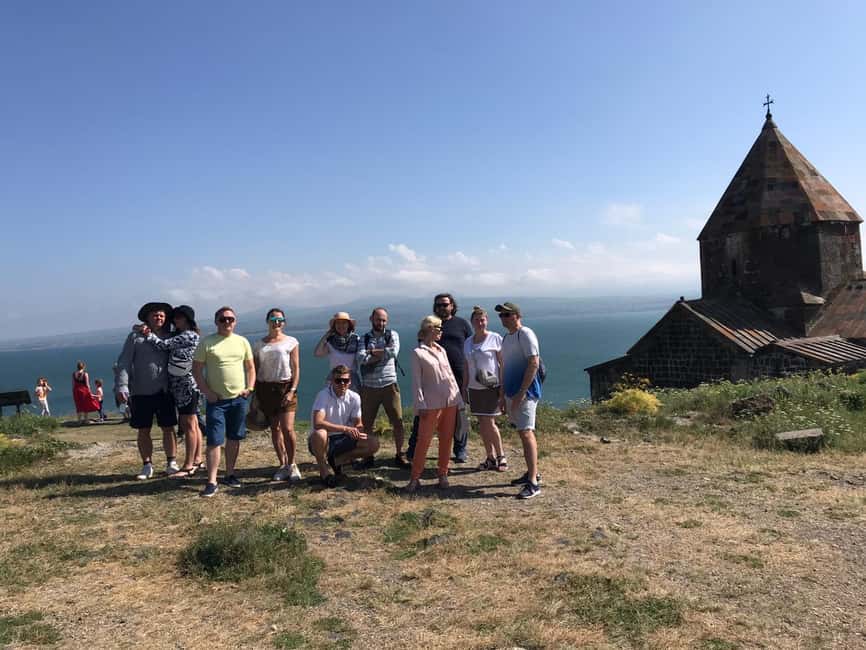
Reviewed · LAKE SEVAN TOURS
Private tour to Lake Sevan, Noratous, Hayravank, Sevanavank
A day around Lake Sevan and two monastery areas is interesting because you get the big setting first, then you slow down for stone details, carvings, and old Armenian church design. It is the kind of trip where the scenery matters, but the architecture and cemetery art are the real payoff.
I like how Sevanavank turns into a storytelling lesson in medieval Armenian building, founded in 874 AD by Princess Mariam, then tied to black tuff and khachkars around the temples. I also love Noratus, because the cemetery is famous for its dense collection of khachkars carved between the 9th and 17th centuries, grouped across clear artistic periods in stone.
One drawback to consider is practical, not dramatic: it is a 7-hour outing with religious sites and photo stops, so you need good shoes and you must follow the dress rule (no shorts or skirts).
Key highlights to look forward to
- Lake Sevan, the Geghama Sea: high-mountain freshwater lake vibes with classic Armenian lake views
- Sevanavank Monastery: 9th-century temples Surb Arakelots and Surb Astvatsatsin on a rocky peninsula
- Black tuff story: the monastery’s construction material is part of why it is often linked to the Black Monastery name
- Noratus Cemetery: 800+ khachkars with carvings spanning 9th to 17th century phases
- Hayravank Monastery: a church, chapel, and gavit from the 9th to 12th centuries, with sun cutting through narrow windows
A 7-hour loop that connects Lake Sevan to medieval stone
This is a straightforward, private-style outing from Yerevan that focuses on three places, each with a different kind of “read the past” experience. Lake Sevan gives you the setting and scale, then Sevanavank shifts you into medieval church design, and Noratus and Hayravank bring you right into the world of carved stone and religious architecture.
What makes it work is that the stops are not jammed with random extras. You get guided time where it counts, plus short stretches for your own pacing and photos. That balance is ideal if you like learning, but you also like looking at details longer than the group pace would normally allow.
One more plus is how the trip is designed for a small group. The price is for a group up to 3, so you can feel more like you are traveling as a unit rather than floating through a busy bus schedule.
More Lake Sevan days:
- Group Tour: Lake Sevan (Sevanavank), Dilijan (Goshavank, Haghartsin)
★ 5.0 · 1,036 reviews - From Yerevan: Lake Sevan & Dilijan Full-Day Group Tour
★ 4.7 · 709 reviews - Group Tour: Tsaghkadzor (Kecharis, Ropeway), Lake Sevan, Trout barbecue treat
★ 5.0 · 511 reviews
How pickups, private guiding, and photo requests really shape the day
You start with pickup from your Yerevan hotel, and the plan returns you back to Yerevan at the end of the day. The tour is private, and you travel in an air-conditioned vehicle with bottled water, which helps when you are out for about 7 hours.
A private car is not just about comfort. It changes how the day feels. I like that you have a driver who also can act like a calm connector, and that matters because your monastery visits will be much more enjoyable if you are not rushing from one thing to the next.
In particular, the name Artur shows up in the feedback as a driver who is punctual and patient. He has also been willing to make photo stops without a fuss. Even if your driver is someone else, the key idea holds: you are not stuck with a rigid “no stops” rhythm.
The best way to get the most out of this format is simple. Tell your driver early what you care about most: khachkars, church details, or lake views. When the priorities are clear, the timing usually feels more fluid.
Sevanavank Monastery on Sevan’s rocky peninsula: two temples, black tuff, and khachkars
Sevanavank is often described as the medieval Armenian architecture highlight on the lake, and it earns that reputation. It sits in the northwest part of Lake Sevan on a narrow rocky peninsula, which means the setting alone already gives you a sense of drama and isolation. You are not just visiting a monument, you are stepping into a location chosen for a reason.
The monastery traces back to 874 AD, founded by Princess Mariam. What you see today includes remnants of 9th-century structures, especially two temples: Surb Arakelots and Surb Astvatsatsin. Those buildings are among a wider field of khachkars around the area, which helps you understand how living faith, carved stone, and architecture can exist in the same space.
Here is the detail I think you will appreciate most: the church buildings were constructed from black tuff. Even if you do not know the material names, you will feel the effect. The darker stone creates a strong contrast against sky and water, and it also ties into why the site is linked to the Black Monastery name.
You also get guided time and then free time. That is your chance to slow down near the temples and look at the junctions, the stone texture, and how the site works as a whole. If you are into photos, this is where you will want to take your time because the peninsula gives you multiple angles with each pause.
Noratus Cemetery: 800+ khachkars and how the carvings change through centuries
Noratus cemetery is the kind of place that stops you mid-sentence. It is famous for its cemetery of khachkars, and this stop is built for close looking, not just passing through.
The oldest part of the cemetery includes over 800 khachkars carved between the 9th and 17th centuries. That is an enormous range, and it is not random. The carvings are grouped into three main development phases, which you will hear about during the guided portion: the 9th to 10th centuries, the 11th to 12th centuries, and the 13th to 16th centuries.
You do not need to memorize dates. The practical value is that you start noticing patterns. Some periods tend to look more formal, others show different carving approaches and stylistic changes. Even if your Armenian reading skills are basic, the shapes and details give you a way to see time as a visual evolution.
The time here is short, about 40 minutes total, with guided tour plus photo stop and your own free time. That short window is a reason to think ahead. Pick a handful of khachkars to really study, then let your camera do the rest. Otherwise, the whole cemetery can blur into “many stones” instead of distinct eras.
One more tip: the cemetery is outdoors, so treat this as a sun and shade planning moment. If your weather is harsh, use the guided time to learn first, then shift to photos once you know where your attention is best spent.
More departures from Yerevan:
- Group Tour: Garni, Symphony of Stones, Geghard, Lavash Baking
★ 5.0 · 1,042 reviews - Garni & Geghard Small-Group Day Trip with Lavash Baking
★ 4.8 · 881 reviews - Khor Virap, Noravank and Birds’ Cave Trip with Wine Tasting
★ 4.8 · 845 reviews - Yerevan: Garni, Geghard, Symphony of Stones & Lavash Baking
★ 4.8 · 758 reviews
Hayravank Monastery: church, chapel, and a gavit shaped by 9th to 12th centuries
Hayravank is the final monastery stop, and it gives you a different kind of experience than Sevanavank and Noratus. This one is more about how the monastery spaces function together.
The site dates to the 9th to 12th centuries, and the three main constructions you will see are the church, the chapel, and a gavit. That layout matters. A gavit is not just an extra building, it helps you understand how monastery life was organized around shared religious and community needs.
The church interior is described as fairly simple, but what makes it “click” for visitors is how the light behaves. When the sun hits through the narrow windows, rays can fall into the interior and change how the whole space feels. This is the kind of effect you cannot fake with a description, so I recommend you take a moment, step back from the crowd, and let your eyes adjust.
You also get time for photos and a free window after the guided portion. Use that free time to focus on one thing: the gavit area layout, or the way the windows line up with the interior view. If you try to do everything at once, you will miss the light effect that people come for.
Practical notes: what to wear, what shoes to bring, and how to avoid discomfort
This tour is outdoors around water and outdoors at cemetery terrain, so your clothing and footwear choices will affect your enjoyment more than you might expect.
Do bring:
- Weather-appropriate clothing
- Sunscreen and a hat
- Comfortable shoes
Do keep it respectful with the dress rule: no shorts or skirts. This is not about being fussy. It is about matching the site expectations so you can move through without hassle.
A couple of small comfort wins:
- If you are sensitive to sun, plan your photo moments for when light looks best, not only when you are most excited.
- Bring a pace mindset. The guided portions are timed, but your free time is yours. Use it to recheck the details that grabbed your attention during the explanation.
Also note that the tour is not suitable for wheelchair users. The itinerary involves monastery and cemetery areas where access details are not provided as wheelchair-friendly.
Price and value: $120 per group up to 3 for a private Sevan day
The cost is $120 per group up to 3, for a total duration of about 7 hours. That pricing structure matters because it turns a longer, multi-stop day into something that can feel reasonable compared to individual add-ons.
You are getting:
- Hotel pickup and drop-off
- An air-conditioned vehicle
- Bottled water
- Guided time at Sevanavank, Noratus, and Hayravank
- Private group time, with the driver also acting as your route and timing support
Meals are not included, but optional meals are mentioned. For value, that means you can keep the day flexible. If you want a sit-down lunch, you can choose it. If you prefer a simple snack break, you can do that too.
When a tour is private and focused on three major sites, the best value shows up in the non-glam parts: less waiting around, better photo timing, and the ability to adjust your pace slightly. This is the kind of trip where those “small” things can add up.
Who should book this Lake Sevan and monastery tour
Book it if you want a day that mixes Lake Sevan views with real Armenian heritage stops, especially if you care about stonework. Sevanavank and Noratus are both built for people who like to look closely, and Hayravank is for people who enjoy architectural atmosphere and sunlight effects.
It is a good fit for:
- Couples and small groups up to 3
- People who want private transport from Yerevan
- Travelers who enjoy guided context, then free time to see details at their own pace
It might not be the best fit if you want a more relaxed, beach-style day on the water. This trip is about monuments, cemeteries, and church design. The lake is a huge part of the setting, but it is not a free-form lounging schedule.
Should you book this private Lake Sevan, Noratus, and Hayravank day?
Yes, if you want one organized day that covers three standout Armenian heritage sites without the stress of logistics. This is especially appealing if you value a calm driver who is punctual and responsive to photo stops, with Artur specifically called out for that style in past outings.
I would book it if your top interests are:
- Sevanavank temples and the black tuff connection
- Noratus khachkars, including the idea of carving phases across centuries
- Hayravank’s church interior light effect and monastery layout
I would hesitate if you dislike outdoor walking or you need wheelchair-friendly access, since the tour is not listed as suitable for wheelchair users. Also, if you hate dress rules, plan around the no shorts and no skirts requirement.
If you want a well-structured day where the details are the main point, this is a strong choice.
FAQ
What is the total duration of the tour?
The tour lasts about 7 hours.
Where does the tour start and end?
Pickup starts from your location in Yerevan, and the tour returns you to Yerevan at the end.
What stops are included?
You visit Sevanavank Monastery, Noratus Cemetery, and Hayravank Monastery.
Is the tour private?
Yes, it is a private group tour. The price is listed per group up to 3.
What is included in the price?
Hotel pickup and drop-off, an air-conditioned vehicle, and bottled water are included.
Are meals included?
No. Meals are not included, but optional meals are mentioned.
What languages are available for the driver?
The driver speaks Armenian, English, and Russian.
Do I need to bring my own water?
No. Bottled water is included, but you should still dress and plan for weather.
What clothing is required?
You should bring weather-appropriate clothing, and avoid shorts and skirts.
Is the tour wheelchair accessible?
No, the tour is not suitable for wheelchair users.
Newest Yerevan write-ups
- Private Tour: Lake Sevan, Sevanavank★ 4.5 · 3 reviews
- Private tour: Garni, Geghard, Symphony of Stones and Sevan★ 5.0 · 3 reviews
- Bottle Your Own Local Sparkling Wine in Dilijan★ 5.0 · 3 reviews
- Armenian South day: Khor Virap, Areni, Karahunj and Tatev★ 5.0 · 3 reviews
- Haghpat & Sanahin UNESCO Sites Tour★ 2.4 · 3 reviews
- Private tour to Gyumri, Dzitoghtsyan Museum, Black Fortress★ 5.0 · 3 reviews
- Yerevan Walking Tour★ 5.0 · 3 reviews
- Private Tour: Tsaghkadzor, Ropeway, Kecharis Monastery, Sevan Lake, Sevanavank★ 5.0 · 3 reviews
Lake Sevan Tours, compared.
Lake Sevan (Sevanavank), Dilijan (Goshavank, Haghartsin)
Read our review →
Tsaghkadzor (Kecharis, Ropeway), Lake Sevan, Trout barbecue treat
Read our review →
Sevan, Dilijan, Haghartsin, Goshavank, Lake Parz
Read our review →
Garni pagan temple, Geghard monastery, Lake Sevan, Sevanavank
Read our review →
Armenia. Akhpat, Dilijan, Sevan, cascad Yerevan from Tbilisi
Read our review →
Tsaghkadzor, Sevan Lake, and Sevanavank Guided Tour
Read our review →
Private 7-8 hour Trip to Garni – Geghard – Lake Sevan – Sevanavank from Yerevan
Read our review →Browse the lists this tour appears in