
Reviewed · ZVARTNOTS TEMPLE TOURS
Echmiadzin (Hripsime, Gayane, Mother Cathedral) and Zvartnots Temple
Armenia’s spiritual heart is packed into a short 4 to 5 hour loop, and that makes this tour especially interesting. You start in central Yerevan and work your way through the Armenian Apostolic Church sites tied to the country’s earliest Christianity, including Echmiadzin and the UNESCO Saint Hripsime and Saint Gayane churches. It’s a lot of meaning in a small amount of time.
Two things I really like: the chance to compare two classic Armenian church designs back-to-back, and the way Zvartnots Temple ruins let you read the architecture like a puzzle. You’ll also see how the stonework and layout connect to Armenia’s identity, not just its sightseeing list.
One drawback to consider is that there’s no lunch included, so you’ll want to plan snacks or eat before the tour. Also, this is a walking and time-on-your-feet style outing, so it helps to have comfortable shoes.
Key highlights at a glance
- UNESCO sites in one half-day: Echmiadzin, Saint Hripsime, Saint Gayane, and Zvartnots Temple.
- Clear architectural comparisons between two church shapes you can spot fast.
- The Echmiadzin Cathedral origin story linked to Armenia becoming the first Christian state.
- Zvartnots Temple’s circular, three-tier design, a different look from typical churches.
- Mount Ararat views from the ruins area when conditions allow.
- Small-tour feel with a maximum of 49 people.
From Republic Square to Echmiadzin, the whole story starts fast
This tour is built for momentum. It starts at Republic Square in Yerevan at 10:00 am, and you end back at the same meeting point. That matters because you are not trying to manage a complicated day with taxis, tickets, or unclear timing. The route is straightforward: you head out to Echmiadzin first, then finish with Zvartnots Temple.
I like the half-day format because it makes sense even if you are also planning other things in Yerevan. In one outing, you get a strong sense of why these places matter, and you are not stuck commuting for the entire day. The tour runs about 4 to 5 hours overall, with the stops designed so you can see, listen, and still keep energy for the next site.
There’s also a practical advantage to the way the tour handles tickets. It uses a mobile ticket, and the admissions are handled in a simple way at the early stops. You will have bottled water included, which is a small detail, but it keeps you comfortable as you move between stone buildings.
If you can, book a little ahead. The tour is often scheduled about 11 days in advance on average, so planning early reduces stress. And because this is a maximum 49-person group, it should feel manageable, not chaotic.
More Zvartnots visits:
- Group Tour: Echmiadzin Cathedral & churches, Zvartnots Temple
★ 5.0 · 352 reviews - Yerevan: Khor Virap, Garni, Geghard, Echmiadzin, & Zvartnots
★ 4.9 · 192 reviews - Private Half-day Echmiadzin Cathedral, Hripsime & Zvartnots Temple from Yerevan
★ 5.0 · 95 reviews
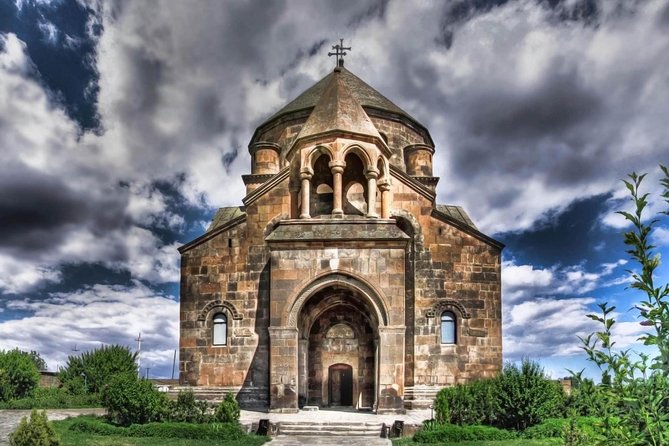
Saint Hripsime Church: classic Armenian cruciform you can recognize quickly
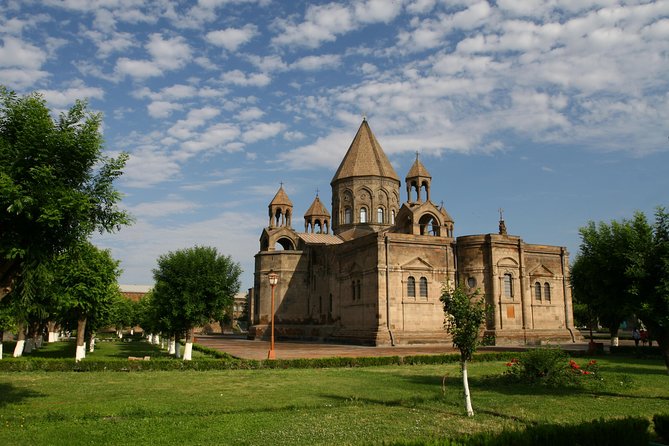
The first UNESCO church stop is Saint Hripsime Church, where the big win is clarity. The site is known for the classic Armenian cruciform design, meaning a cross-shaped layout, topped with a dome and built with massive stone walls. Even if you do not know architectural terms, you can still grasp the form because the design is so direct.
You get about 30 minutes here. That’s usually enough time to see the exterior shape, take in the dome profile, and get the main historical context from your guides. The best move is to slow down for a moment near key angles so you understand the building’s cross layout, not just the walls you are facing at the moment.
Another plus is that the admissions are free at this stop, so you are not juggling extra ticket steps in the middle of the day. It also keeps the experience feeling focused on the place and the story, instead of admin.
What I find especially valuable about Saint Hripsime is how it sets a baseline. Once you’ve registered this cruciform, dome-on-stone look, the next church stop becomes a direct comparison rather than separate sightseeing. You end up with a mental checklist of what Armenian church architecture can look like.
Saint Gayane Church: a different plan, same spiritual weight
Right after Saint Hripsime, you move to Saint Gayane Church. The architectural shift is the point. Instead of the cross-shaped plan, you are looking at a more rectangular basilica design with a dome, heavy stone walls, and carved arches.
This stop also lasts about 30 minutes, which keeps your pacing steady. Again, you’re not forced into rushing. You have time to look for the main geometric difference, then zoom in on the details. The carved arches are the kind of feature you appreciate more when you already understand the overall structure from the prior stop.
You also get a human story tied to the church. Saint Gayane was one of the Christian virgins who fled the Roman Empire with Saint Hripsime. That detail helps the architecture feel less abstract. The buildings are not just ancient objects. They connect to people and movement, to survival and faith.
Like Saint Hripsime, this church stop has free admission, so your focus stays on what you see and what you learn from your guides. By the end, you should be able to describe the difference between the two church plans, even if you only had a short time at each.
Echmiadzin Monastery and Mother Cathedral: why the whole country orbits here
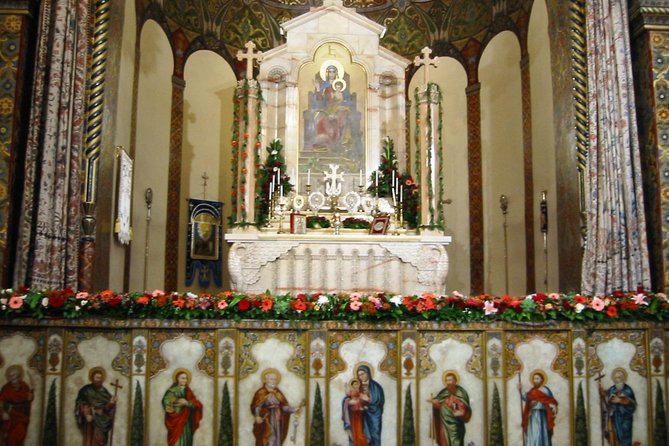
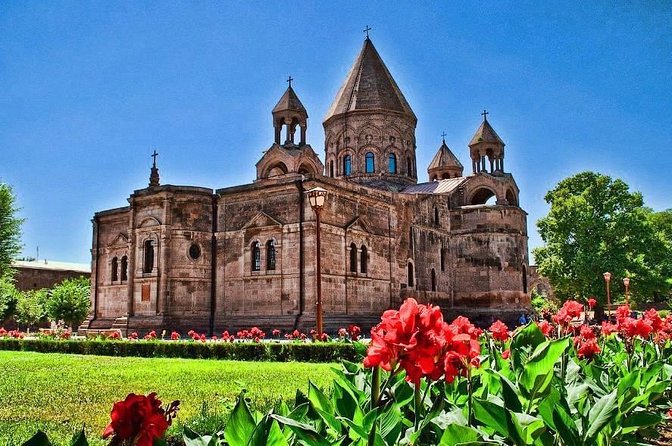
Now you step into the main event: Echmiadzin Monastery, including Echmiadzin Cathedral. This is the mother church of the Armenian Apostolic Church and a religious center of Armenia. It’s also listed as a UNESCO World Heritage Site, which signals that this is not just locally important.
Here’s why this stop hits. You are visiting a cathedral tied to one of the earliest turning points in Armenian Christianity. The building is linked to the period 301 to 303 AD, built by Saint Gregory the Illuminator after Armenia adopted Christianity as its state religion. That timeline gives the site weight. You are not just seeing old architecture. You are seeing architecture connected to early state-level Christianity.
You’ll have about 1 hour here. That length matters because cathedrals are usually more than one thing. You need time to understand the space, listen to the story, and take in how the religious function shapes what you notice.
There’s also a practical reason the hour helps. People often feel the urge to photograph everywhere at once. With a longer stop, you can do your photos early, then slow down for the interpretive part of the visit without feeling like you are running out of time.
One note from the experience vibe: if your timing lines up right, you might catch a religious ceremony on Sundays, which can make the atmosphere feel more alive. I’m not counting on it, but it is worth considering if your schedule has flexibility. Also, the cathedral interior may look especially impressive if there has been recent renovation, so give yourself time to look beyond the first glance.
More Echmiadzin visits:
- Private tour to Echmiadzin (st Cathedral), Zvartnots, Khor Virap, Garni, Geghard
★ 5.0 · 67 reviews - Private 8-9-hour Echmiadzin, Zvartnots, Garni and Geghard trip from Yerevan
★ 5.0 · 62 reviews - Khor Virap, Echmiadzin & Zvartnots UNESCO Small-Group Guided Tour
★ 5.0 · 40 reviews - Garni, Geghard, Echmiadzin and Zvartnots Private Tour
★ 4.8 · 30 reviews
Zvartnots Temple ruins: circular, three-tier, and built to be seen
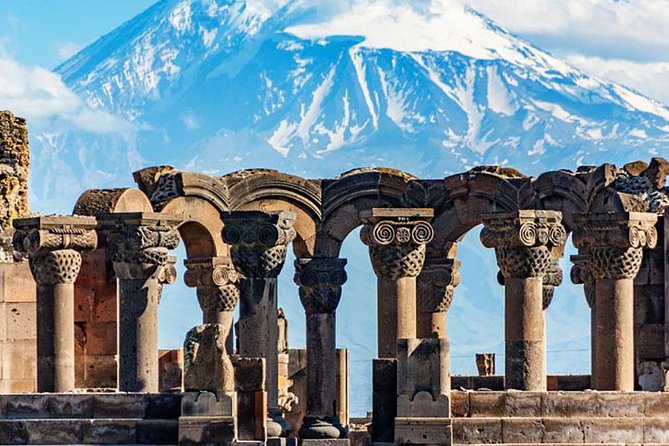
The tour’s final major site is Zvartnots Temple, a 7th-century cathedral now in ruins. This is where you get the most “wait, what am I looking at?” moment, because Zvartnots is not built like a typical Armenian church.
Unlike the other churches you saw, Zvartnots had a circular, three-tiered structure influenced by Byzantine and Armenian designs. That combination is part of the intrigue. You’re looking at a place where Armenian identity and outside architectural influence overlap, at least in style and form.
You’ll get about 45 minutes here, and admission is included for this stop. So from a planning standpoint, it’s easy. You show up, you walk the ruins, and you listen.
One of the most memorable parts of Zvartnots is the setting. The experience includes chances for panoramic views of Mount Ararat. Even when the view is partly blocked, the ruins still work because the scale of the stonework makes it feel bigger than a quick stop. You end up understanding how the site might have dominated the landscape.
My advice: take a few minutes to look at the ruins from different angles. The circular shape reads better when you see how the tiers would have layered. It’s also a good spot for photos, but keep a little time for your eyes first. The ruins can look like random stone until you connect the structure to the three tiers idea.
Guides, pacing, and what this tour does well with your time
The experience is guided, and the structure is built to keep you moving without rushing your thinking. You get a local guide plus a professional guide, and that combination usually helps because you get both on-the-ground context and a clear historical narrative.
The pacing works like this: short stops at the churches keep the day energetic, and then Echmiadzin gets the time it needs. By the time you reach Zvartnots, you are ready for something visually different, not just another long church.
I also like the small included comfort: bottled water. It’s not exciting, but it prevents the classic half-day trip problem where you start thirsty, then start skipping attention to details.
Admissions are mostly handled simply too. Stops for Saint Hripsime and Saint Gayane are free, and Echmiadzin Cathedral access is free as well. Zvartnots Temple includes admission in the tour cost. This setup makes the total day feel predictable.
If there’s one thing you should watch for, it’s food. The tour does not include lunch. If you go hungry, you will rush the last stop or feel distracted when you should be enjoying the architecture. Even a light snack before you start can make the whole day feel smoother.
Price, value, and who should book Echmiadzin plus Zvartnots
At $20.00 per person, this is one of those prices that feels like it was made for travelers who want value without sacrificing meaning. You are paying for guided interpretation, transportation between the sites, and the core access to major UNESCO places. That’s a lot for a half-day budget.
The value gets even better because many admissions are free at multiple stops, so you are not paying extra surprises once you arrive. Zvartnots is included with admission, and water is included too. Put it together and you get a day that is mostly about the sites, not about spending time managing purchases.
This tour makes the most sense if you:
- want the big Armenia Christian landmarks in one outing
- enjoy architecture and want to compare church designs side by side
- prefer a short, guided day rather than self-driving or stitching together a DIY plan
- are visiting with limited time in Yerevan
It may be less ideal if:
- you need a full lunch break as part of your schedule
- you want to spend long hours inside each church without a guided time limit
- you dislike walking between multiple stops, even if the overall time is only 4 to 5 hours
One more practical thing: the group size limit of 49 helps keep the experience social without feeling like you’re part of a stadium event.
Should you book this tour?
I think you should book it if you want a smart, efficient way to understand Armenia’s early Christian architecture through Echmiadzin, Saint Hripsime, Saint Gayane, and Zvartnots Temple in one day. The price is fair, admissions are handled cleanly, and the pacing gives you time to actually look, not just stand in front of buildings.
The key decision for you is simple: if you can handle no lunch and a half-day schedule, this is an easy yes. If you need a longer, slower day with food built in, you might prefer a different option.
FAQ
How long is the tour?
The tour lasts about 4 to 5 hours (approx.).
What is the price per person?
The price is $20.00 per person.
Where does the tour start and end?
It starts at Republic Square in Yerevan, and it ends back at the same meeting point.
What time does the tour begin?
The start time is 10:00 am.
What is included in the tour price?
The tour includes bottled water, a local guide, and a professional guide.
Is lunch included?
No, lunch is not included.
Is a ticket provided for this experience?
Yes, it uses a mobile ticket.
How many people can be in the group?
The tour has a maximum of 49 travelers.
What is the cancellation policy?
You can cancel for a full refund up to 24 hours in advance. If you cancel less than 24 hours before the start time, the amount paid is not refunded.
Newest Yerevan write-ups
- Private tour: Garni, Geghard, Symphony of Stones and Sevan★ 5.0 · 3 reviews
- Private Tour: Lake Sevan, Sevanavank★ 4.5 · 3 reviews
- Bottle Your Own Local Sparkling Wine in Dilijan★ 5.0 · 3 reviews
- Armenian South day: Khor Virap, Areni, Karahunj and Tatev★ 5.0 · 3 reviews
- Haghpat & Sanahin UNESCO Sites Tour★ 2.4 · 3 reviews
- Private tour to Gyumri, Dzitoghtsyan Museum, Black Fortress★ 5.0 · 3 reviews
- Yerevan Walking Tour★ 5.0 · 3 reviews
- Private Tour: Tsaghkadzor, Ropeway, Kecharis Monastery, Sevan Lake, Sevanavank★ 5.0 · 3 reviews
Zvartnots Temple Tours, compared.
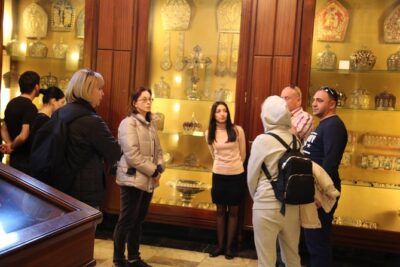
Echmiadzin Cathedral & churches, Zvartnots Temple
Read our review →
Khor Virap, Garni, Geghard, Echmiadzin, & Zvartnots
Read our review →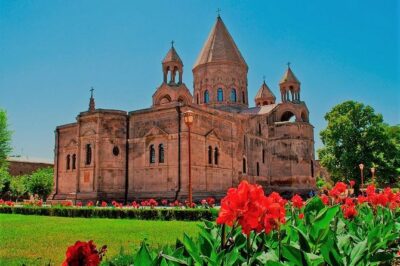
Private Half-day Echmiadzin Cathedral, Hripsime & Zvartnots Temple from Yerevan
Read our review →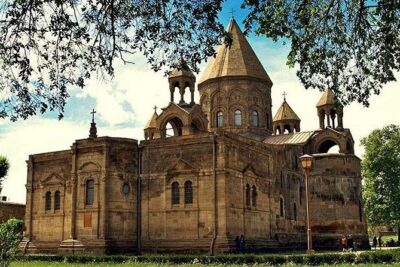
Private tour to Echmiadzin (st Cathedral), Zvartnots, Khor Virap, Garni, Geghard
Read our review →
Khor Virap, Echmiadzin & Zvartnots UNESCO Small-Group Tour
Read our review →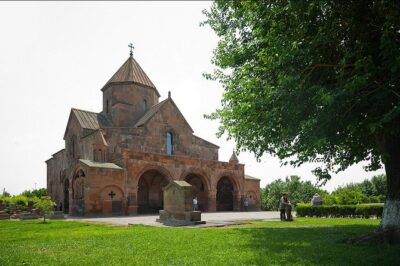
Private 8-9-hour Echmiadzin, Zvartnots, Garni and Geghard trip from Yerevan
Read our review →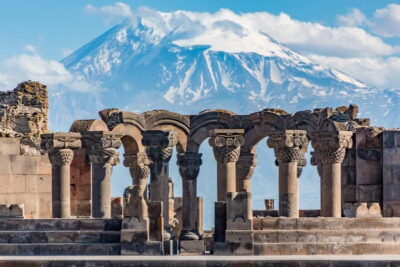
Echmiadzin, Hripsime, Gayane, Zvartnots Temple Tour
Read our review →
Khor Virap, Echmiadzin & Zvartnots UNESCO Small-Group Guided Tour
Read our review →Browse the lists this tour appears in